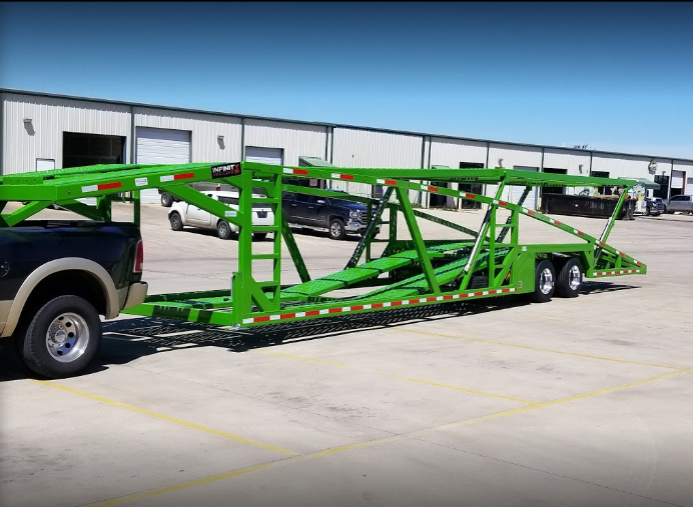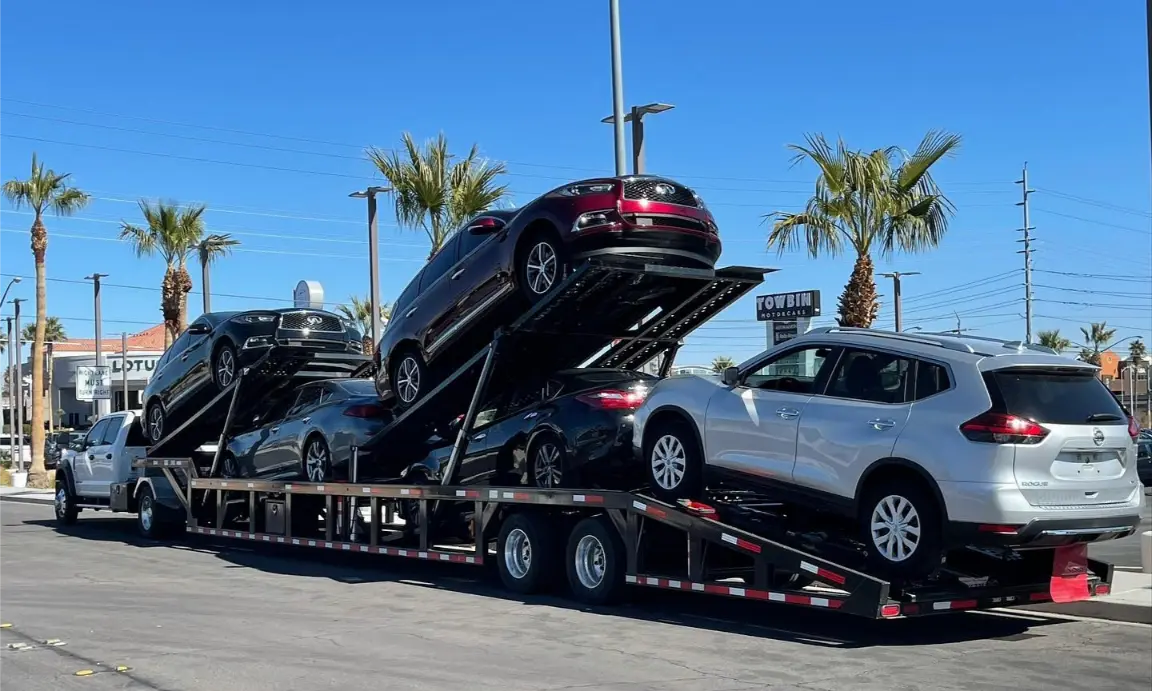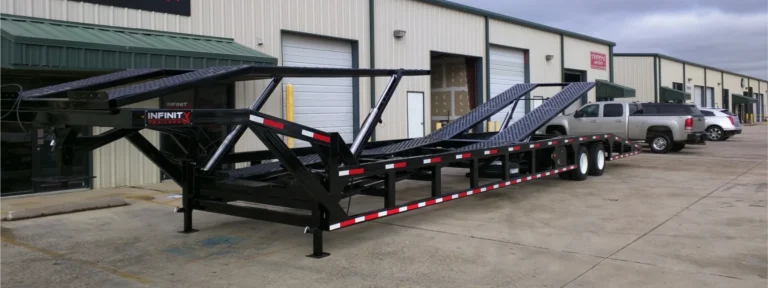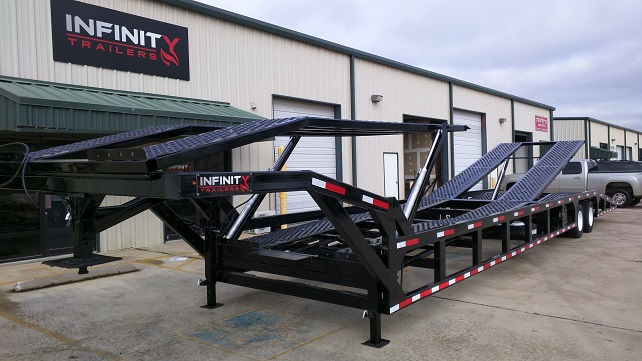
If you haul newer cars, sports cars or anything with a low front spoiler, you already know the sound of a bumper scraping a steep ramp. That’s the problem a low pro car hauler is built to solve. Our GN450 and GN550 (and their GNW versions for pickup trucks) are 53-foot low pro car haulers with two 16-foot hydraulic tilt decks. Here’s how a tilt deck works, how it changes loading, how the low pro models compare with our drive-over belly deck haulers, and how to keep the hydraulics working season after season.
What “low pro” means on a car hauler
“Low pro” is short for low profile. On a car carrier trailer, it means the decks are designed to sit low and load at a gentler angle, so vehicles with less ground clearance can drive on without scraping. Instead of relying only on long ramps to climb onto a fixed deck, a low pro hauler uses deck sections that tilt hydraulically, bringing the deck down to meet the car.
How a hydraulic tilt deck works
A tilt deck is a section of the deck that pivots, raised and lowered by hydraulic cylinders. On our low pro models, everything runs off the trailer’s own hydraulic system:
- A 12-volt single-acting hydraulic pump and onboard 12-volt battery supply the power.
- Aluminum hydraulic cylinders raise and lower the upper decks, and separate cylinders operate the hydraulic loading ramps.
- A dual pole plug with a 4-gauge charge wire lets your truck keep the trailer battery charged while you drive.
When you’re ready to load, you use the pump to tilt the deck section down to a shallower angle, drive the car up, then raise the deck back to its travel position. Because the deck itself becomes part of the ramp, the approach is longer and more gradual than a short, steep ramp onto a fixed deck. That’s what protects front bumpers, air dams and exhaust.
Why haulers choose a low pro 4 or 5 car hauler
- Less scraping on low cars. A gentler loading angle helps protect the front ends and undersides of newer vehicles, which matters when you’re hauling dealer inventory that has to arrive damage-free.
- More flexible loads. Tilting deck sections let you position cars where they fit best, so it’s easier to mix sedans, SUVs and pickups on the same trip.
- Faster loading. Hydraulic ramps and tilt decks mean less manual work at each stop. When you’re making several pickups a day at dealers and auctions, that time adds up.
- Hydraulic ramps standard. On every Infinity trailer, hydraulic loading ramps come standard at no extra charge.
Our low pro models at a glance
| Model | Cars | Truck | Length | Top deck | Bottom deck | Starting price |
|---|---|---|---|---|---|---|
| GN450 | 4 | Chassis cab | 53 ft | 32 ft | 36 ft | $48,900 |
| GNW450 | 4 | Pickup bed | 53 ft | 32 ft | 36 ft | $48,900 |
| GN550 | 5 | Chassis cab | 53 ft | 32 ft | 44 ft | $57,900 |
| GNW550 | 5 | Pickup bed | 53 ft | 32 ft | 44 ft | $57,900 |
All four have two 16-foot hydraulic tilt decks, hydraulic loading ramps, two 12,000 lb Dexter axles with tandem duals and hydraulic brakes, a 25,900 lb GVWR and a 2-inch kingpin. The 5 car GN550 gives you 76 feet of total loading space, and the 4 car GN450 gives you 68 feet.
Low pro vs drive-over belly deck: which is right for you?
We build two styles of multi car trailer:
- Low pro (53 ft): GN450, GN550 and their GNW versions. Two hydraulic tilt decks for gentler loading. A great fit if you haul a lot of low-clearance vehicles, newer dealer inventory or mixed loads.
- Drive-over belly deck (50 ft): our GN500 5 car hauler and GN600 6 car hauler (and GNW versions). A shorter overall trailer with a drive-over belly deck for quick loading. The GN600 gives you 90 feet of loading space and the most capacity in our lineup.
If you mostly haul trucks and SUVs, the shorter 50-foot trailers are easier to maneuver in tight lots. If you haul a lot of cars that sit low, a low pro hauler will save you headaches. Our article on choosing between a 50-foot and 53-foot 5 car trailer goes into more detail.
Loading tips for a tilt deck car hauler
- Park level. Load on flat, firm ground with the truck and trailer straight.
- Check the battery. Make sure the trailer battery is charged and the dual pole charge line is connected. A weak battery means a slow pump.
- Plan the load. Put heavier vehicles where they keep weight balanced over the axles and the kingpin, and decide the order before the first car goes on.
- Lower, load, raise. Tilt the deck down, drive the car on slowly with a spotter, set the parking brake, then raise the deck to travel position.
- Strap every wheel. Use over-the-wheel straps, and check them again after the first few miles.
- Stow everything. Confirm ramps and tilt decks are up and locked before you pull out.
Our full guide on how to load and strap cars on a car hauler covers load planning and tie-downs step by step.
Keeping the hydraulics healthy
- Look for leaks at the cylinders, fittings and hoses during your daily walk-around.
- Keep the battery charged. Check the charge wire connection and battery terminals for corrosion.
- Check the fluid level in the pump reservoir regularly, and use the fluid type the pump maker recommends.
- Protect the hoses from rubbing or pinching where decks move.
- Fix problems early. A slow or jerky deck usually means low fluid, a weak battery or a leak. Catching it early keeps a small fix from becoming downtime.
Frequently asked questions
Which Infinity car haulers have hydraulic tilt decks?
Our 53-foot low pro models: the GN450 and GNW450 (4 car) and the GN550 and GNW550 (5 car). Each has two 16-foot hydraulic tilt decks.
Do all Infinity trailers have hydraulic ramps?
Yes. Hydraulic loading ramps come standard on every Infinity trailer at no extra charge.
What powers the hydraulics?
A 12-volt hydraulic pump and onboard 12-volt battery, kept charged by your truck through the dual pole charge line.
Is a low pro car hauler right for a dually or a chassis cab?
Both. The GN450 and GN550 are built for chassis cab trucks, and the GNW450 and GNW550 are built for trucks with a pickup bed, including a dually.
See the low pro lineup
Check out the 4 car haulers and 5 car haulers for sale, see financing options, or contact Infinity Trailers in Haslet, Texas, to talk through which deck style fits the cars you haul.
Last reviewed November 18, 2026.