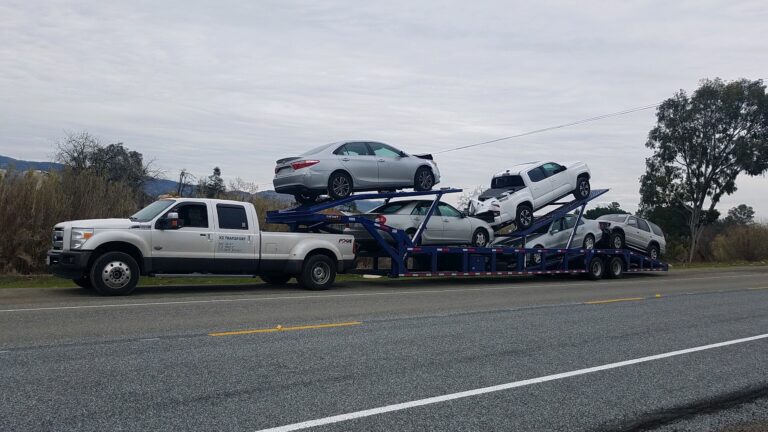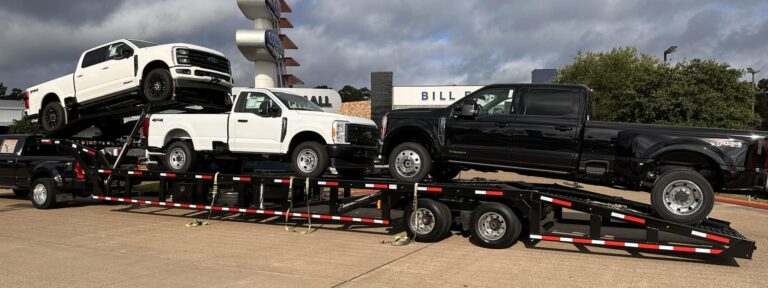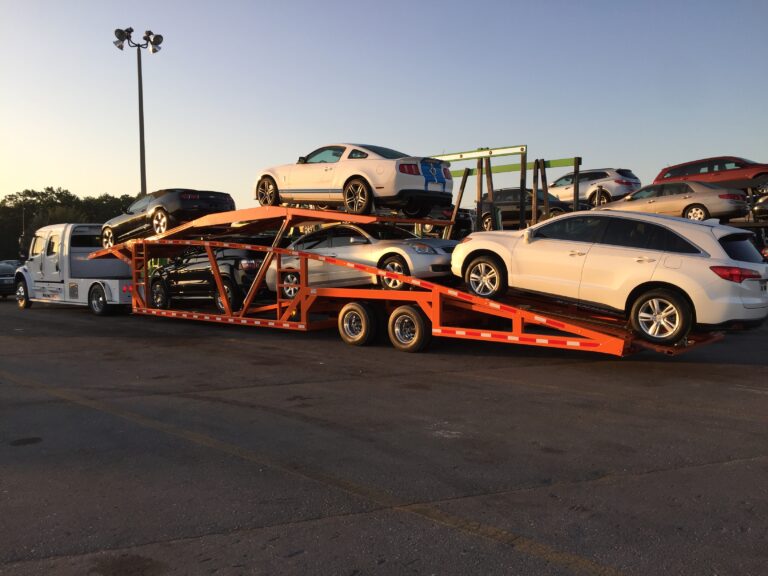
Towing in Texas comes with its own set of rules, and they matter even more when you’re pulling a heavy trailer like a car hauler. This guide covers the main Texas trailer and towing laws: brakes, safety chains, driver’s license classes, motor carrier registration, and size limits, with notes on how they apply to a multi-car hauler.
This is a general overview, not legal advice. Laws change, so check with the Texas Department of Public Safety (DPS) and the Texas Department of Motor Vehicles (TxDMV) for your exact situation.
Last reviewed November 18, 2026 against the Texas Transportation Code and DPS and TxDMV rules (sources listed at the end).
Trailer brakes
Under Texas Transportation Code §547.401, trailers generally need brakes. A trailer, semitrailer or pole trailer isn’t required to have brakes only if its gross weight is 4,500 pounds or less (the only other exception is a trailer between 4,500 and 15,000 pounds pulled at no more than 30 mph). When brakes are required, they must be kept in working condition.
A loaded car hauler is far over that limit. Every Infinity Trailers car hauler comes with Dexter tandem dual axles and Dexter hydraulic brakes, and your truck needs an electric over hydraulic brake controller to run them.
Safety chains
Texas Transportation Code §545.410 requires safety chains when a passenger car or light truck tows a trailer. DPS rules set the type of chain by trailer weight, and the chains must be strong enough to keep the trailer connected if the hitch fails. Chains should never drag on the road.
For commercial vehicles, the federal rule (49 CFR §393.70(d)) requires safety chains or cables on full trailers and converter dollies, not on semitrailers coupled to a fifth wheel. A fifth wheel car hauler connects by its kingpin, so check with DPS which rule applies to your truck and setup.
What driver’s license do you need?
Texas DPS bases license class on the weight ratings of your truck and trailer, not on what you’re hauling that day:
- Class A is required to drive a combination of vehicles with a gross combination weight rating (GCWR) of 26,001 pounds or more when the trailer’s gross vehicle weight rating (GVWR) is over 10,000 pounds.
- If you operate in commerce, you’ll need a Class A commercial driver license (CDL). Texas also issues a non-commercial Class A for combinations used for non-commercial purposes.
What this means for car haulers: Infinity 4, 5 and 6 car haulers have a 25,900 lb GVWR. That’s over the 10,000 lb trailer threshold, and once you add any truck’s GVWR the combination is well over 26,001 lb, so plan on a Class A license. Most of our customers run car haulers as a business, which means a Class A CDL. If you’re not sure which applies to you, ask DPS before you buy.
Motor carrier registration (TxDMV number)
If you haul only inside Texas, TxDMV requires motor carrier registration (a TxDMV number) when you operate a vehicle or combination with a gross weight, registered weight or gross weight rating of more than 26,000 pounds on Texas roads. You’ll need a USDOT number from the Federal Motor Carrier Safety Administration first.
- Hauling only inside Texas (intrastate): register with USDOT as intrastate, then get your TxDMV number and keep proof of insurance on file.
- Hauling across state lines (interstate): federal rules apply, including your USDOT number and, for for-hire carriers, operating authority and Unified Carrier Registration.
Trailer registration
Most non-farm trailers used on Texas public roads must be registered, and titling depends on the trailer’s weight. Register your new trailer with your county tax office; your sales paperwork and invoice will be needed.
Size limits
Texas limits vehicle width to 8 ft 6 in (102″) and height to 14 ft. Infinity car haulers are 102″ wide, so they’re within the width limit. On a stacked car hauler, the loaded height is what counts, so watch tall vehicles on the top deck and keep the load under 14 ft unless you have a permit.
Lights
Your trailer’s tail lights, brake lights, turn signals and clearance lights must all work. Infinity trailers use Optronics all-LED lighting. Check every light each time you hook up.
Safe and legal towing checklist
- The right license class for your truck and trailer combination
- USDOT and TxDMV numbers if you’re over 26,000 lb and operating commercially
- Trailer registered, with paperwork in the truck
- Brakes working and the brake controller set up
- Safety chains connected where required, off the ground
- Lights working, and loaded height under 14 ft
- Load secured with straps on every vehicle
For hitch basics, see our guide to trailer hitch classes and types; for safe driving habits, read our trailer towing safety tips.
Texas towing laws: quick answers
Can a 16-year-old tow a trailer in Texas?
Texas doesn’t list a separate towing age on its DPS license pages. What matters is holding the right license class for the truck and trailer combination. Drivers 16 and 17 have a provisional license with extra rules until they turn 18: no more than one passenger under 21 who isn’t family, no driving between midnight and 5 a.m. except for work, school or a medical emergency, and no phone use while driving. A loaded car hauler usually needs a Class A license (see below).
What is the maximum trailer width in Texas?
102 inches (8 feet 6 inches), including the load. Mirrors and other approved safety devices don’t count toward the width. Every Infinity car hauler is built 102 inches wide.
Do trailers have to be registered in Texas?
Yes. All non-farm trailers used on public roads must be registered through your county tax assessor-collector. A manufactured trailer with a gross weight over 4,000 pounds must also be titled. A new trailer is titled and registered with the Manufacturer’s Certificate of Origin (MCO) from the builder.
When does a trailer need brakes in Texas?
When its gross weight is over 4,500 pounds. The only exception is a trailer between 4,500 and 15,000 pounds pulled at no more than 30 mph. A loaded car hauler always needs working brakes.
What license do I need to pull a car hauler in Texas?
A Class A license when the truck and trailer together are rated 26,001 pounds or more (GCWR) and the trailer alone is rated over 10,000 pounds (GVWR). Texas issues a non-commercial Class A for personal use. If you haul cars for hire, you’ll need a Class A commercial driver license (CDL). Infinity car haulers are rated 25,900 pounds GVWR, so a Class A is needed with any truck.
Sources (last reviewed November 18, 2026). Laws change, so check with DPS or TxDMV before you haul.
- Texas Transportation Code §547.401 (trailer brakes)
- Texas Transportation Code §545.410 (safety chains)
- Texas Transportation Code §621.201 and §621.207 (width and height)
- Texas DPS: Classes of Driver Licenses (license classes)
- Texas DPS: Graduated Driver License (provisional license rules)
- TxDMV: Motor Carrier Registration (TxDMV Number) (intrastate registration)
- TxDMV: Trailers (registration and titles)
- FMCSA: 49 CFR §393.70 (coupling devices and safety chains)
Buying a car hauler in Texas?
Infinity Trailers builds 4, 5 and 6 car haulers in Haslet, in the Dallas–Fort Worth area. Compare our 4, 5 & 6 car auto hauler trailers, check the truck requirements, or call us at 806-655-5500.