This article is a general overview of the federal cargo securement rules, not legal advice. Rules can change, so check the current regulations and your state’s requirements.
Every car on your car hauler trailer is someone else’s property, and the federal rules for strapping it down are more specific than a lot of new haulers expect. Securement is also one of the first things an officer looks at during a roadside inspection. Here’s what the rules actually say about securing cars, light trucks and vans on a 4, 5 or 6 car hauler, how to check your strap math, and the mistakes that most often lead to citations or damage claims.
Which rule applies to cars on a car hauler?
Federal cargo securement rules are in 49 CFR Part 393, Subpart I. There’s a general set of rules for all cargo, plus commodity-specific rules for certain loads. Cars have their own section:
- 49 CFR 393.128 covers automobiles, light trucks and vans that individually weigh 10,000 lb or less. That’s almost everything you’ll haul on a multi car trailer.
- Vehicles heavier than 10,000 lb fall under the heavy vehicle and equipment rules in 393.130 instead, which have stricter requirements.
The general rules in Subpart I still apply alongside 393.128, including the rules on working load limits and the condition of your straps.
What 393.128 requires
For cars, light trucks and vans, the core requirements are:
- At least two tiedowns per vehicle, restraining it at both the front and the rear so it can’t move side to side, forward, backward or up and down.
- Tiedowns attached to the vehicle’s structure must use mounting points on the vehicle that are designed for that purpose, not suspension parts, bumpers or other weak points.
- Tiedowns that go over or around the wheels must restrain the vehicle in every direction: side to side, front to back and up and down.
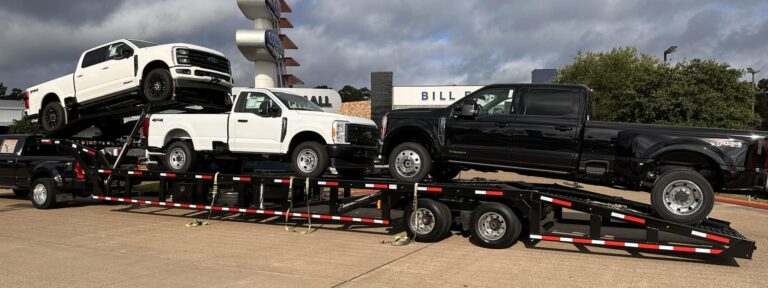
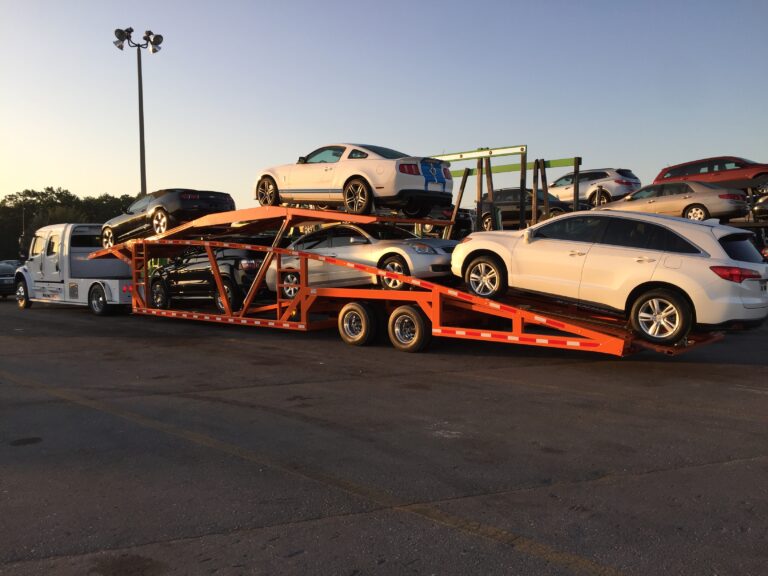
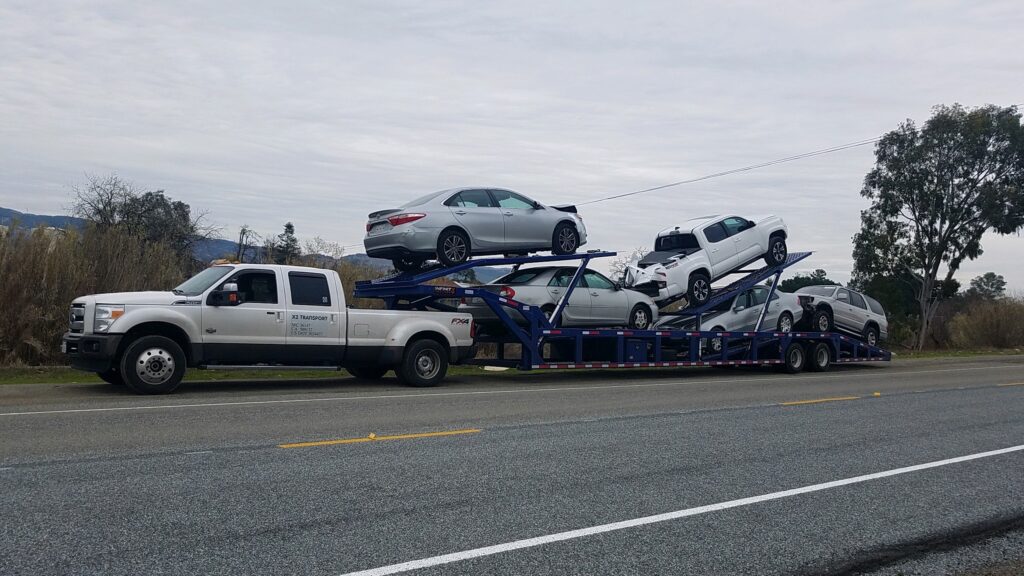
Two is the legal minimum, not the target. Most car haulers strap all four wheels, and every Infinity car hauler comes with 20 over-the-wheel straps with swivel hooks so you can do exactly that on a full load.
Working load limit: the math most people get wrong
Every strap, chain, hook and anchor has a working load limit (WLL), the maximum load it’s rated to handle in normal use. Federal rules add two requirements that matter on every car you load:
- The WLL of a tiedown is the lowest rating in the system. A strap rated higher than its hook, ratchet or the anchor point it’s attached to only counts at the weakest part’s rating.
- The aggregate WLL must be at least half the vehicle’s weight. Add up the WLL of every tiedown on that vehicle, and the total has to equal at least 50 percent of what the vehicle weighs.
Here’s the part many drivers miss: not every tiedown counts at its full rating. Under the general rules, a tiedown that runs from an anchor on the trailer to an anchor point on the vehicle counts at half its WLL. So does a strap that runs from the trailer, over or around the cargo, and back to an anchor on the same side of the trailer, which is how an over-the-wheel strap usually works. Only a tiedown that crosses the cargo and attaches on the opposite side of the trailer counts at its full rating.
A quick example
| Step | Example |
|---|---|
| Vehicle weight | 5,000 lb crossover |
| Required aggregate WLL (50%) | 2,500 lb |
| Tiedowns used | 4 over-the-wheel straps, each rated 3,300 lb WLL |
| How much each counts | Half its rating: 1,650 lb |
| Aggregate WLL | 4 × 1,650 = 6,600 lb, more than the 2,500 lb required |
The example uses round numbers. Always use the WLL marked on your actual straps and hardware, and the real weight of the vehicle from the door sticker or manufacturer specs. If a strap isn’t marked with a WLL, don’t guess.
Inspect the load on the road, not just at pickup
Securement isn’t a one-time job. Under 49 CFR 392.9, the driver of a commercial vehicle must:
- Make sure the load is properly secured before driving.
- Re-inspect the cargo and tiedowns within the first 50 miles of the trip and adjust as needed.
- Re-check them again whenever the driver changes duty status, or after 3 hours or 150 miles of driving, whichever comes first.
Straps settle as tires flex and the load shifts slightly in the first few miles, so that 50-mile check often finds something to tighten.
The securement mistakes that cause problems
- Counting every strap at full WLL. As shown above, most car hauler tiedowns only count at half. Run the math with that in mind.
- Worn or damaged straps. Tiedowns can’t have damage, like cuts, frays or cracked hooks, that weakens them. Replace damaged straps instead of hoping they’ll make one more trip.
- Weak attachment points. Hooking to suspension or steering parts, or to bumpers, can damage the vehicle and doesn’t meet the rule for structural tiedowns.
- Loose straps. A strap that isn’t tight enough to keep the vehicle from moving isn’t doing its job, whatever it’s rated.
- Skipping the en-route checks. Most loose straps are found at the first stop. Make that stop part of every trip.
- No photos. Photograph each vehicle’s securement before you leave. It’s your best defense if a damage claim comes up later.
A securement routine that works on any car hauler
- Confirm each vehicle’s weight and plan where it goes on the trailer.
- Check every strap, hook and ratchet for wear before you load.
- Load, set the parking brake and put the vehicle in park.
- Strap all four wheels where possible, and keep straps clear of brake lines, sensors and body panels.
- Tighten everything, then walk the load and check each strap again.
- Photograph each vehicle from several angles.
- Re-check within 50 miles, then every 3 hours or 150 miles.
Our step-by-step guide on how to load and strap cars on a car hauler walks through load order and strap placement, and our DOT inspections guide covers the rest of what an officer looks at.
Frequently asked questions
How many straps do I need per car?
The federal minimum for cars, light trucks and vans is two tiedowns, restraining the vehicle at the front and rear. Your straps also have to add up to at least half the vehicle’s weight in working load limit. Most haulers strap all four wheels.
Does the rule change for heavy pickups or EVs?
The car rule in 393.128 covers vehicles up to 10,000 lb. Some electric trucks are heavy, but most still fall under it. A vehicle over 10,000 lb falls under the heavy vehicle rules in 393.130. Either way, heavier vehicles need more total working load limit to meet the 50 percent rule.
Do these rules apply to a pickup pulling a car hauler?
The securement rules apply to commercial motor vehicles in interstate commerce, which includes most for-hire car haulers pulling a loaded multi car trailer. Strapping every car properly is the right practice whatever you’re driving.
Built to haul and strap right
Every Infinity car hauler comes with 20 over-the-wheel straps, hydraulic loading ramps and Dexter axles with hydraulic brakes. Compare our 4 car, 5 car and 6 car hauler trailers for sale in Texas, or contact Infinity Trailers in Haslet.
Last reviewed November 18, 2026.
Sources:
- 49 CFR 393.128, securement of automobiles, light trucks and vans (Cornell LII)
- 49 CFR 393.106, general securement requirements and aggregate working load limit (Cornell LII)
- 49 CFR 393.108, how the working load limit is determined (Cornell LII)
- 49 CFR 392.9, inspection of cargo and securement devices (Cornell LII)