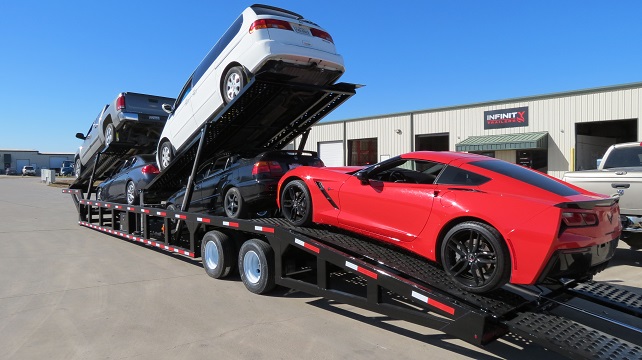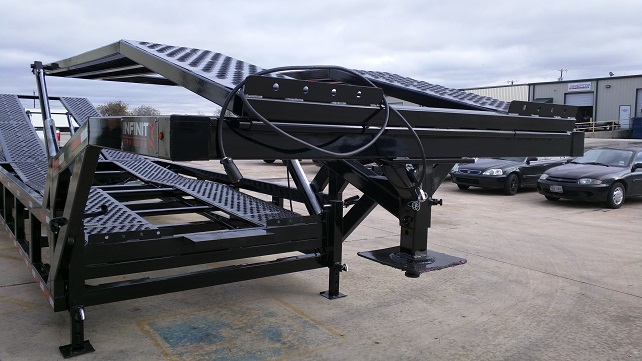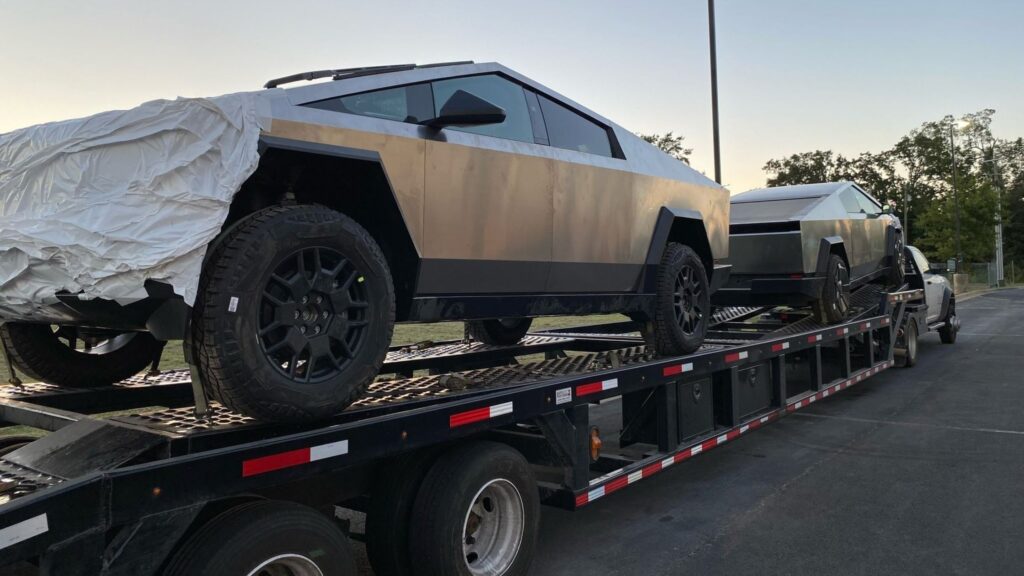
Dealers and auctions are moving more electric vehicles every year, and anyone running a car hauler notices the difference the first time they load a few. EVs are heavier than most gas cars of the same size, sometimes by thousands of pounds. On a fifth wheel car hauler, that extra weight changes how many vehicles you can legally carry, where they go on the trailer, and how you strap them. Here’s what to know before you take your next load of EVs on a 4, 5 or 6 car hauler.
How much heavier are EVs?
Battery packs are heavy, and they make up a big share of an electric vehicle’s weight. A few examples show how wide the range is:
- Ford F-150 Lightning: published curb weights run from about 6,000 lb to roughly 6,900 lb depending on trim and battery.
- GMC Hummer EV Edition 1: GM’s filing with the EPA listed a curb weight of 9,063 lb, with a battery pack weighing 2,923 lb on its own.
The weight varies a lot by model, so don’t guess. Check the door-jamb sticker or the manufacturer’s specs for each vehicle you’re hauling.
Why it matters more on a fifth wheel car hauler
Every trailer has a gross vehicle weight rating (GVWR), the most the trailer and everything on it can weigh. Every Infinity car hauler is rated at 25,900 lb GVWR. That number includes the trailer itself, so the weight you can actually load is:
| Number | Where to find it |
|---|---|
| Trailer GVWR | The VIN plate on the trailer |
| Trailer empty weight | A scale ticket for your trailer as you run it (straps, winch and gear included) |
| Available payload | GVWR minus empty weight |
Your axle and tire ratings matter too, and so does your truck. Part of the trailer’s weight rides on your fifth wheel hitch, so the load also counts against your truck’s rear axle rating, payload and gross combined weight rating (GCWR). See what truck you need to pull a car hauler for the truck side.
A quick illustration
Five 4,000 lb sedans add up to 20,000 lb of cargo. Swap three of them for 6,000 lb electric pickups, and the same five slots now hold 26,000 lb. That’s 6,000 lb more on the same trailer, with the same number of cars. Depending on your trailer’s payload, a load of EVs may mean leaving a slot empty.
Plan EV loads before you accept them
- Know your real empty weight. Weigh your truck and trailer empty, with your normal gear, on a certified truck scale. Keep the ticket.
- Ask for the vehicle list up front, including year, make and model, so you can look up weights.
- Add it up against your trailer’s available payload, your axle ratings and your truck’s ratings.
- Leave a buffer. Don’t plan to load right to the limit. Running one car short costs less than an overweight citation or a reload at the scale.
- Weigh the loaded rig when you’re unsure, especially on your first few EV loads.
Where to put heavy vehicles on the trailer
- Keep weight balanced over the axles and the kingpin. Too much weight at the back can take weight off your truck’s rear axle. Too much up front can overload it.
- Put the heaviest units low when you can. A lower center of gravity helps stability.
- Think about unloading order so you’re not rearranging heavy vehicles at every stop.
Our guide on how to load and strap cars on a car hauler goes deeper on load planning.
Loading and strapping EVs
- Watch the underside. Many EVs carry their battery pack under the floor. Never hook straps or a winch line to the battery area. Use wheel straps, or the tie-down and tow points the manufacturer specifies.
- Low ground clearance. Many newer vehicles sit low. On our 53-foot low pro car haulers with hydraulic tilt decks, a gentler loading angle helps protect the front end and underside.
- Know how to put it in neutral. Some EVs need a specific procedure or a transport mode to roll freely. Check the owner’s manual or ask the shipper before you arrive.
- A dead EV can be a non-runner. If the battery is flat, it may not shift into neutral or release the parking brake. See our guide to hauling inoperable vehicles.
- Heavier vehicles need more strap capacity. Federal rules require your tiedowns to add up to at least half the vehicle’s weight in working load limit. A vehicle over 10,000 lb falls under the stricter heavy vehicle rules. Our article on car hauler securement rules walks through the math.
Driving with a heavy load
A fully loaded car hauler with several EVs takes longer to stop and handles differently on grades and in crosswinds. Leave more following distance, check your brakes and tire pressures before every trip, and re-check your straps within the first 50 miles and at every stop.
Frequently asked questions
How many EVs can I haul on a 5 car hauler?
It depends on the specific vehicles, your trailer’s available payload (GVWR minus empty weight), your axle ratings and your truck. Add up the actual weights for each load instead of assuming every slot can be filled.
Where do I find my trailer’s GVWR?
It’s on the VIN plate on the trailer. Every Infinity car hauler is rated at 25,900 lb GVWR. Weigh the trailer empty with your gear to know your real payload.
Can I strap an EV by its frame?
Only at the tie-down points the manufacturer specifies, and never to the battery pack. Wheel straps are usually the safest choice.
Talk through your loads with us
If you’re planning to haul a lot of EVs, call us before you buy. We can talk through the trailer, axle options and truck setup that fit the vehicles you haul. Compare our 4 car, 5 car and 6 car hauler trailers for sale in Texas, or contact Infinity Trailers in Haslet.
Last reviewed November 18, 2026.
Sources: