Loading a multi-car hauler takes more than driving cars up a ramp. Where each vehicle sits affects how the trailer tows, whether the load clears bridges, and whether you pass a roadside inspection. This guide covers how to load a car hauler step by step, how to plan the load, and how to strap down cars so they stay put.
Before you load: set up the truck and trailer
- Park on firm, level ground, with the truck and trailer in a straight line. Soft ground or a slope changes how the trailer sits once weight goes on.
- Keep the trailer hitched. Load with the trailer coupled to the truck so it can’t tip or shift as weight comes on. Set the truck’s parking brake.
- Check the connection: fifth wheel jaws locked on the kingpin, electrical plug connected, and trailer lights and brakes working.
- Inspect the trailer: decks, ramps and tie-down points free of damage and debris, and the hydraulic system charged.
- Clear the area and agree on hand signals with anyone helping. A spotter should stand off to the side, never between vehicles or under a deck.
Plan the load before the first car goes on
Know what you’re hauling and where each vehicle will go before you lower the ramps. Good load planning follows a few rules:
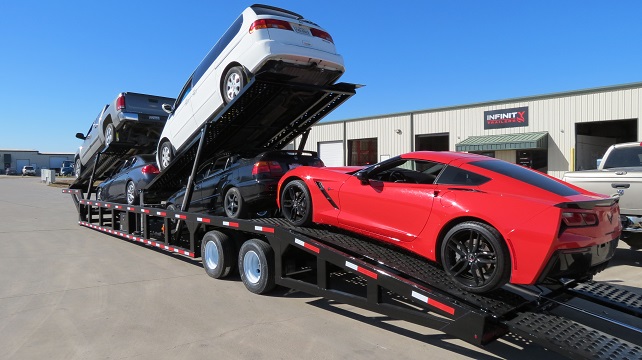
- Weight low and forward. Put the heaviest vehicles on the lower deck and slightly ahead of the trailer axles, so the trailer doesn’t get tail-heavy and sway.
- Balance side to side. Center every vehicle on its track.
- Watch your height. Pickups and SUVs often go on the top deck because of their height, but the load still has to clear overpasses. In Texas, a vehicle and its load can’t be higher than 14 feet without a permit, so measure tall loads before you leave.
- Load in delivery order. The vehicle you drop off first should be the easiest to unload, so you aren’t moving three cars to reach one.
- Non-running vehicles need a winch. Don’t count on pushing a dead car up a ramp. A winch (like the 12K WARN VR12 wireless winch option on Infinity trailers) pulls it on under control.
How to load a car hauler, step by step
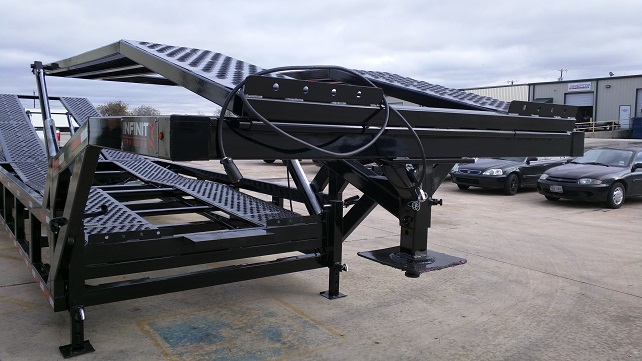
- Lower the ramps and make sure they’re seated evenly. On Infinity trailers the loading ramps are hydraulic, so you set them from the trailer’s hydraulic controls.
- Position the decks. Tilt or lower the deck you’re loading. Our low pro models (GN450, GNW450, GN550, GNW550) have two 16 ft hydraulic tilt decks; the GN500, GNW500, GN600 and GNW600 have a drive-over belly deck.
- Line the car up straight with the ramp, wheels pointed forward.
- Drive up slowly and steadily, without stopping halfway or turning the wheel. Stopping with the drive wheels on a ramp can make the tires spin.
- Stop on your mark, put the car in park (or in gear for a manual), set the parking brake and shut it off.
- Strap it down right away, before you move a deck or load the next vehicle (see below).
- Raise or level the deck and repeat for the next vehicle, following your load plan.
- Stow the ramps and lock everything in its travel position.
How to strap down cars on a car hauler
Federal cargo securement rules for automobiles, light trucks and vans (49 CFR 393.128) require each vehicle to be restrained at the front and rear with at least two tiedowns, so it can’t move side to side, forward, backward or up. Tiedowns that attach to the vehicle itself must use mounting points designed for that purpose.
Two is the legal minimum, but most car haulers strap all four wheels. That’s why Infinity trailers come with four over-the-wheel straps per vehicle: 16 on the 4 car models, 20 on the 5 car models and 24 on the 6 car models.
- Use wheel straps on modern cars. Over-the-wheel straps hold the tire, so they don’t touch the body or pull against the suspension.
- Use rated gear. Every strap should have a legible working load limit label. Replace straps that are cut, frayed or sun-damaged.
- Snug, then tighten. Tighten evenly so the car doesn’t get pulled off its mark.
- Don’t strap to parts that can bend, such as control arms, tie rods or the exhaust.
Before you pull out
- Walk around the whole trailer: every strap tight, every deck locked, ramps stowed.
- Check loaded height against your route.
- Test lights and brakes again.
- Drive a short distance, then stop and recheck every strap. Straps settle as the load shifts in the first few miles.
- Recheck at every fuel or rest stop, and after any hard brake.
Unloading
Unload in reverse: park level, keep the trailer hitched, release one vehicle at a time, and remove its straps only when you’re ready to drive it off. Keep everyone clear of the ramps and decks while a vehicle is moving.
Common car hauler loading mistakes
- Loading on a slope or soft ground
- Putting heavy vehicles at the back of the trailer
- Forgetting to measure a tall top-deck load
- Strapping to suspension parts instead of the wheels
- Skipping the strap check after the first few miles
For more, see our trailer towing safety tips and Texas trailer and towing laws.
A car hauler built for fast, safe loading
Every Infinity Trailers car hauler comes with hydraulic loading ramps, a self-contained hydraulic system, and the straps you need for every position. Compare our 4 car, 5 car and 6 car haulers, or call us at 806-655-5500.