Category: Uncategorized

  • Car Hauling Trends to Watch in 2026

    Car Hauling Trends to Watch in 2026

    Car hauling keeps changing, and the haulers who do best are the ones who adjust their equipment and their business to match. Here are the car hauling trends we see shaping the industry in 2026, and what each one means when you choose your next trailer.

    1. Vehicles are traveling farther between buyer and seller

    More vehicles are bought and sold online and through auctions, so a car is often sold hundreds of miles from where it sits. That keeps steady demand for transport, especially longer runs between cities. For haulers, it means more highway miles, which makes running gear, tires and brakes matter even more.

    What it means for your trailer: choose axles and tires built for the miles. Our 4 car and 5 car haulers come with two 12,000 lb Dexter axles and tandem duals, upgradeable to 15K, and our 6 car haulers come with 15K axles standard. See tandem axle trailers explained.

    2. Haulers want more cars per trip

    Fuel, insurance and driver time cost about the same whether your trailer is full or half empty. Moving more vehicles per trip spreads those costs further, which is why many operators step up from 4 car to 5 car or 6 car haulers.

    What it means for your trailer: look at loading space, not just the number of spots. Our GN600 gives you 90 ft of loading space on a 50 ft trailer, and our GN550 offers 76 ft. Compare sizes in 4 car vs 5 car vs 6 car hauler.

    3. Faster loading is a competitive edge

    Time spent loading and unloading is time you aren’t driving or getting paid. Customers also expect quick, damage-free pickups and drop-offs.

    What it means for your trailer: hydraulic equipment pays for itself in time saved. Our trailers come standard with hydraulic loading ramps and, depending on the model, either hydraulic tilt decks or a drive-over belly deck. A wireless winch is available for non-running vehicles. See how to load a car hauler.

    4. Technology is part of the job

    Digital load boards, GPS tracking, electronic logs and photo inspection apps are now everyday tools for many haulers. Customers increasingly expect real-time updates and documented vehicle condition at pickup and delivery.

    What it means for your business: pair good equipment with good systems. A reliable trailer keeps you on schedule, and the right apps help you prove it to your customers. See car shipping documents.

    5. Buyers want clear prices and straight answers

    Transport businesses watch every dollar, and they want to know exactly what they’re paying for before they commit.

    What it means when you shop: compare base prices, what’s included and the warranty. At Infinity Trailers, base prices are listed on every product page, hydraulic ramps and tandem duals come standard, and every trailer is warranted for one year against manufacturing defects in workmanship. Financing is available through several equipment lenders. See our car trailer buying guide.

    6. More owner-operators are starting with hotshot car haulers

    A heavy-duty truck with a 4 to 6 car fifth wheel hauler costs far less to start than a semi car carrier, so many new haulers start this way and grow from there. See hotshot vs flatbed trucking and how to start a car hauling business. Our hotshot car hauler trailer guide covers models and prices.

    Frequently asked questions

    Which size car hauler is best for a growing business?

    It depends on how many vehicles you move per trip today and expect to move soon. Our 4 car vs 5 car vs 6 car comparison walks through how to decide.

    How long does it take to get a new trailer?

    Our trailers are built to order, on average in four to eight weeks after we receive your deposit. Call or text us for the current lead time.

    Where is Infinity Trailers located?

    We’re in Haslet, Texas, in the Dallas–Fort Worth area. Customers pick up their trailers at our facility.

    Ready for your next trailer?

    Browse our 4 car, 5 car and 6 car haulers, or call us at 806-655-5500.
  • Types of Car Haulers: Open, Enclosed, Wedge, Multi-Car & More

    Types of Car Haulers: Open, Enclosed, Wedge, Multi-Car & More

    “Car hauler” covers everything from a single-car tilt trailer to a 9-car semi rig. The right type depends on how many vehicles you move, what truck you drive, and what kind of cars you haul. This guide explains the main types of car haulers, what each one is best for, and how to choose.

    Open vs enclosed car haulers

    Every car hauler starts with one choice: open or enclosed.

    • Open car haulers leave vehicles exposed. They’re lighter, cost less, carry more cars per trip and load faster. Most dealer, auction and broker work moves on open trailers.
    • Enclosed car haulers protect vehicles from weather and road debris. They carry fewer cars and cost more, so they’re mostly used for classic, exotic and high-value vehicles.

    We compare the two in detail in 5 car hauler vs enclosed trailer.

    The main types of car haulers

    1. Single-car trailers (flatbed and tilt deck)

    A bumper-pull or gooseneck trailer that carries one vehicle, loaded with ramps or a tilting deck. Good for moving your own car, race cars and local tows. Simple and affordable, but one car per trip limits earnings for a business.

    2. Hotshot gooseneck flatbeds

    A dually or chassis cab truck pulling a gooseneck flatbed that carries one to three vehicles. Popular for short-notice jobs, non-running vehicles and tight delivery spots. See hotshot vs flatbed trucking.

    3. Wedge trailers

    A gooseneck trailer with a deck that slopes up toward the front, usually carrying two to four cars on a single level. A wedge is lighter and cheaper than a two-deck hauler, but carries fewer vehicles.

    4. Multi-car fifth wheel haulers (4 to 6 cars)

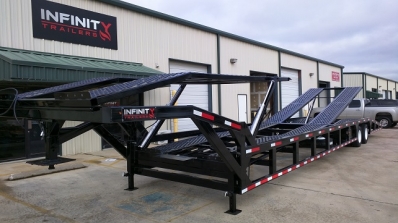
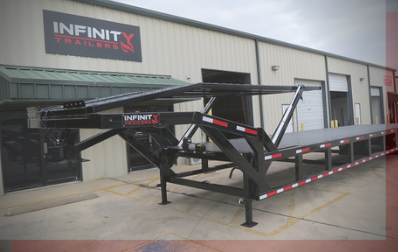
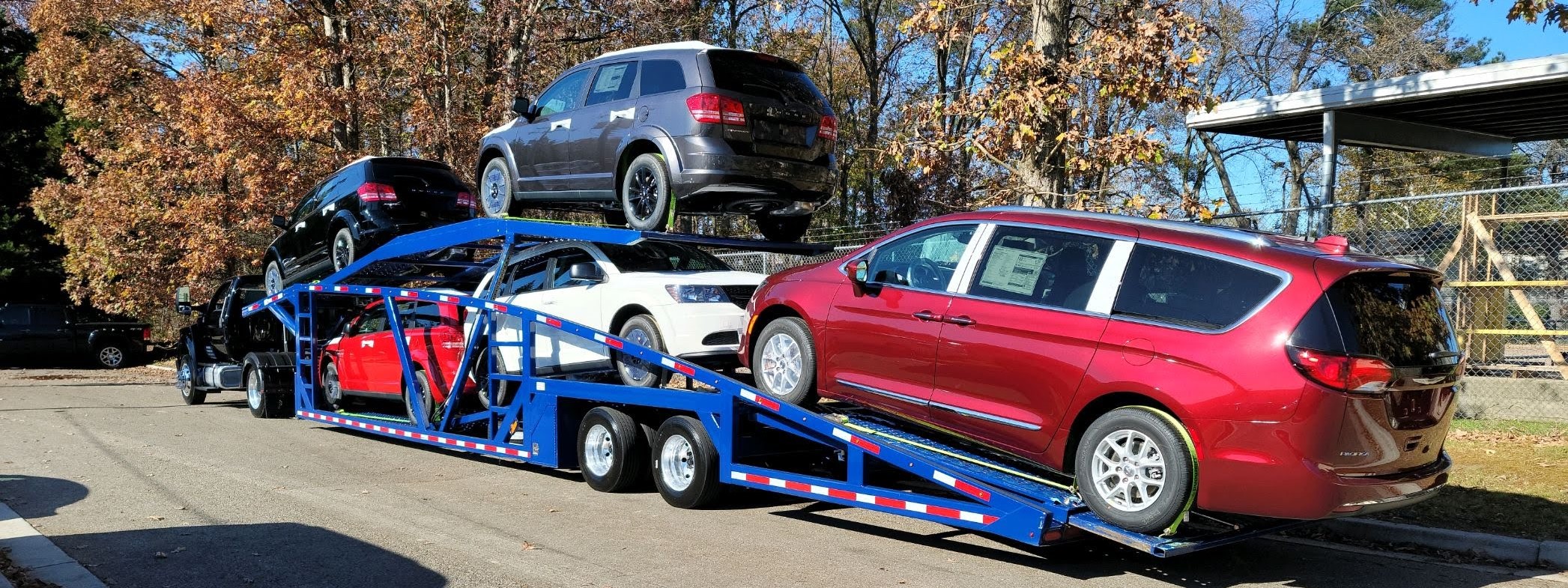
    Two-level trailers pulled by a heavy-duty pickup or chassis cab truck, carrying four to six vehicles with hydraulic ramps and decks. They give an owner-operator semi-like capacity without a semi tractor, which makes them the most popular choice for growing auto transport businesses. This is what Infinity Trailers builds.

    5. Stinger-steer car carriers

    The large semi rigs you see moving new cars. The trailer connects low behind the tractor, and many have an extra deck over the cab, carrying up to nine or ten vehicles. They need a Class 8 tractor, a CDL and a big investment.

    6. High-mount car carriers

    Semi car carriers that hook to a standard fifth wheel on the tractor, like a regular semi-trailer. They usually carry seven or eight vehicles and the tractor can pull other trailers too.

    7. Enclosed car trailers

    Box trailers in single-car, multi-car gooseneck and semi sizes. Some have lift gates to carry low cars. Best for collectors, auction houses and exotic car transport.

    Types of car haulers compared

    Type Typical capacity Truck needed Best for
    Single-car trailer 1 Pickup Personal use, local tows
    Hotshot flatbed 1–3 Dually or chassis cab Urgent and non-running vehicles
    Wedge trailer 2–4 Dually or chassis cab Starting out, lighter loads
    Multi-car fifth wheel 4–6 Heavy-duty pickup or chassis cab Owner-operators, dealer and broker work
    High-mount semi carrier 7–8 Class 8 tractor High volume, flexible fleets
    Stinger-steer semi carrier 9–10 Class 8 tractor New-car and long-haul volume
    Enclosed trailer 1–7 Varies High-value and classic cars

    How to choose the right type of car hauler

    • Volume: how many cars can you fill on most trips? Multi-car trailers only pay off when they run full.
    • Your truck: a heavy-duty pickup or chassis cab can pull up to a 6-car fifth wheel hauler; more than that needs a semi tractor.
    • Licensing: heavier combinations need a Class A license and, for hire, a CDL and DOT numbers. See Texas trailer and towing laws.
    • Vehicle type: standard cars and trucks travel open; high-value cars may call for enclosed.
    • Budget: compare the cost per car spot, not just the trailer price.

    Infinity Trailers multi-car haulers

    We build open, two-level fifth wheel car haulers in Haslet, Texas, in three sizes:

    • 4 car haulers: GN450 and GNW450, 53 ft low pro with two 16 ft hydraulic tilt decks, from $48,900
    • 5 car haulers: GN500 and GNW500 (50 ft) from $52,900, and GN550 and GNW550 (53 ft low pro) from $57,900
    • 6 car haulers: GN600 and GNW600, 50 ft with 90 ft of loading space, from $59,900

    GN models are for chassis cab or hotshot trucks; GNW models are for trucks with a pickup bed. Every trailer has hydraulic loading ramps, Dexter tandem dual axles with hydraulic brakes, and LED lighting. Not sure which size? Read 4 car vs 5 car vs 6 car hauler, or call or text 806-655-5500.

  • How Long Does a Car Trailer Last? Car Hauler Maintenance Checklist

    How Long Does a Car Trailer Last? Car Hauler Maintenance Checklist

    “How long does a car trailer last?” depends less on the calendar and more on how the trailer is built, how hard it works, and how well it’s maintained. A well-built car hauler that’s inspected and serviced on schedule can stay on the road and earning for many years. A neglected one wears out fast. This guide covers what affects car trailer lifespan and gives you a car hauler maintenance checklist to keep yours working.

    What affects how long a car trailer lasts

    • Build quality: frame design, welds, axles, suspension and hydraulics all decide how well a trailer holds up under years of heavy loads. Name-brand components (like Dexter axles, Hutch suspension and Optronics LED lights) are easier to service and find parts for.
    • How it’s used: overloading, rough roads and hard stops shorten the life of axles, tires, decks and hydraulics.
    • Maintenance: bearings, brakes, tires and hydraulics need regular service. Most expensive failures start as small, cheap fixes that got skipped.
    • Weather and storage: sun, rain and road salt attack paint, wiring, hoses and tires. Rust that starts at a chip spreads if it isn’t touched up.

    Car hauler maintenance checklist

    The intervals below follow Dexter’s recommended maintenance schedule for its axles and brakes, the axles used on every Infinity car hauler. Always follow the manuals that came with your trailer and its components.

    Before every trip

    • Test the trailer brakes and brake controller.
    • Check tire pressure (cold) on all eight tires and the spare; look for cuts, bulges and uneven wear.
    • Check wheel nuts are tight to the specified torque.
    • Test all lights: brake, turn, tail and clearance.
    • Inspect the kingpin, fifth wheel connection and plugs.
    • Check the hydraulic system: fluid level, hoses and fittings for leaks, and battery charge.
    • Inspect straps for cuts, fraying or sun damage, and check ramps and decks for damage.

    Every 6 months or 6,000 miles

    • Inspect brake components for wear and correct operation, and check the brake controller settings.
    • Inspect suspension parts for wear or loose parts.
    • Inspect wheels for cracks or damage.

    Every 12 months or 12,000 miles

    • Remove the hubs, inspect and repack (or replace) the wheel bearings, and replace the grease seals.
    • Inspect brake linings, drums and hardware, and service the brakes.
    • Inspect the frame, crossmembers and welds for cracks or rust.
    • Service the hydraulic system per the pump manufacturer, and inspect cylinders for leaks.
    • Check all wiring and connectors for corrosion or damage.

    As needed

    • Touch up paint chips and scratches before rust starts.
    • Wash off mud and road salt, especially underneath.
    • Replace tires when worn or aged; trailer tires can age out before the tread wears out, especially in the Texas sun.
    • Re-torque wheel nuts after any wheel or tire is removed and remounted.

    Signs your trailer needs attention

    • Hot hubs after a run, or grinding or squealing from a wheel
    • Uneven or fast tire wear
    • Trailer pulling to one side or weak braking
    • Slow or jerky hydraulic ramps or decks
    • Flickering lights or blown fuses
    • Cracks in welds, or rust spreading from chips

    Tips to make your car hauler last longer

    • Stay within the trailer’s 25,900 lb GVWR, and load heavy vehicles low and forward. See how to load a car hauler.
    • Drive smoothly: gentle starts and stops are easier on the axles, brakes and tires.
    • Keep a maintenance log with dates and miles.
    • Park on firm, level ground and keep the trailer covered when you can.
    • Fix small problems right away.

    More reading: trailer wheels and tires, tandem axle trailers and common towing mistakes.

    Built to work, backed by a warranty

    Every Infinity Trailers car hauler is built in Haslet, Texas, with Dexter tandem dual axles and hydraulic brakes, a Hutch H-9700 suspension, Roadmaster 18 ply tires and Optronics LED lighting, and comes with a one year warranty against manufacturing defects in workmanship. Browse our car hauler trailers for sale, or call or text 806-655-5500.

  • Car Shipping Documents: What You Need to Ship a Car

    Car Shipping Documents: What You Need to Ship a Car

    Paperwork protects everyone in a car shipment: the vehicle owner, the hauler and the broker. For a domestic move, the list is shorter than most people expect, but the documents that matter really matter. This guide covers the essential car shipping documents, what each one does, and the paperwork car haulers should carry on every load.

    1. Bill of lading (BOL)

    The bill of lading is the most important document in any car shipment. It acts as the contract, the receipt and the vehicle condition report in one. At pickup, the driver and the customer inspect the vehicle together and mark any existing damage on the BOL. At delivery, they inspect it again and compare.

    • For customers: note every scratch and dent at pickup, and inspect carefully before signing at delivery. Damage not noted on the BOL is hard to claim later.
    • For haulers: never skip the pickup inspection. A complete BOL protects you from claims for damage that was already there.

    2. Vehicle condition report and photos

    Many carriers use a separate condition report or an inspection app alongside the BOL, with date-stamped photos of every side of the vehicle, the odometer and any damage. Photos taken at pickup and delivery settle most disputes quickly.

    3. Insurance information

    • Carrier’s insurance: commercial car haulers carry liability and cargo insurance. Customers and brokers should ask for a certificate of insurance and check the cargo coverage is enough for the vehicles being moved.
    • Owner’s insurance: owners should know what their own policy covers during transport.

    4. Vehicle information and ID

    Have the year, make, model and VIN ready when booking, plus contact names and numbers at both ends. Many carriers also ask to see photo ID at pickup and delivery.

    Do you need the title to ship a car? For a domestic move, usually not. Transporting a vehicle isn’t the same as transferring ownership, and most carriers don’t ask for the title. Some situations, like auction pickups, dealer releases or vehicles with a lien, need extra paperwork.

    5. Release forms and authorizations

    • Auction or dealer gate pass / release: needed to pick up a vehicle from an auction or dealer lot.
    • Lienholder authorization: may be needed for financed or leased vehicles in some cases, especially for moves by sea (for example, to Hawaii) or out of the country.
    • Owner authorization: if someone other than the owner will release or receive the vehicle.

    International shipping needs more

    Exporting a vehicle requires the original title, export and customs paperwork, and sometimes documents from the destination country’s consulate. Requirements vary by country, so work with a licensed international shipper.

    Paperwork every car hauler should carry

    If you run a car hauling business, keep these with you or easily available on every load:

    • Your driver’s license (Class A or Class A CDL as required) and medical card if applicable
    • Truck and trailer registration
    • Proof of insurance (liability and cargo)
    • USDOT number and, as applicable, MC number or TxDMV number, marked on your truck
    • Bills of lading and condition reports for every vehicle on board
    • Gate passes and release forms
    • Logs or ELD records if required for your operation

    Learn more in how to start a car hauling business and Texas trailer and towing laws.

    Car shipping documents checklist

    • Bill of lading, signed at pickup and delivery
    • Condition report and photos
    • Carrier certificate of insurance
    • Vehicle details and VIN
    • Photo ID
    • Gate pass, release or lienholder authorization if needed

    Hauling cars for a living?

    Infinity Trailers builds 4, 5 and 6 car haulers in Haslet, Texas, with hydraulic ramps, Dexter tandem dual axles and four straps per vehicle. Browse our car hauler trailers for sale, or call or text 806-655-5500.

  • Car Hauler Trailer Financing: How It Works & Who to Call

    Car Hauler Trailer Financing: How It Works & Who to Call

    Most people who buy a car hauler don’t pay cash; they finance it. Car hauler trailer financing lets you put a new trailer to work now and pay for it over time, often out of the money the trailer earns. This guide explains how trailer financing works, what to prepare before you apply, and which lenders already finance Infinity Trailers car haulers.

    How does trailer financing work?

    Car haulers are usually financed as equipment, the same way businesses finance trucks and construction machinery. In simple terms:

    1. You choose your trailer. Pick the model and options on our trailer pages; prices are listed online, starting at $48,900.
    2. You apply with an equipment lender. You can call a lender directly or apply online through their website.
    3. The lender reviews your application and, if approved, offers terms: the amount, the length of the loan or lease, and the payment.
    4. The lender pays for the trailer and you make regular payments to the lender.

    Rates, terms and down payments are set by each lender and depend on your situation, so it pays to talk to more than one.

    Lenders that finance Infinity Trailers

    We work with these equipment financing companies, who already know our trailers. Contact them directly, or use the links on our financing page to apply online:

    • AMUR Equipment Financing: Staci Moore, (214) 801-6653
    • Ascentium Capital: Brian Zetting, (480) 580-1642
    • Beacon Hill Funding: Anthony Olenio, (781) 428-4078
    • Commercial Fleet Financing: Aaron Nguyen, (469) 701-9014
    • Dext Capital: Jeff Mills, (972) 922-0800
    • JR Capital Equipment Financing: Dominic Napoli, (949) 633-3440
    • Key Credit Corp.: Kristin Lamote, (770) 998-9922
    • Montana Commercial Credit, Inc.: Andrea Bell, (406) 268-9840
    • Partners Capital Group Inc.: Jacey Fischer, (949) 484-7398

    What to have ready before you apply

    Every lender has its own application, but being prepared speeds things up. Have these handy:

    • The trailer you want and its price. Each Infinity trailer page shows the base price and option prices, and the Calculated Price updates as you pick options, so you can tell the lender the exact amount.
    • Your business details: business name, how long you’ve been operating, and the type of hauling you do.
    • Your contact and ID details as the lender requests them.
    • Your truck details. Make sure your truck meets our truck requirements (fifth wheel with a 2″ kingpin and 32K or greater capacity) so the trailer can go to work as soon as you pick it up.

    Is financing a car hauler worth it?

    For many transport businesses it is, because the trailer starts earning right away instead of you saving up for months. A few things to weigh:

    • Cash flow: financing keeps cash in your business for fuel, insurance and repairs.
    • Total cost: interest adds to what you pay over the life of the loan, so compare offers from several lenders.
    • Size and earning power: a bigger trailer costs more but moves more vehicles per trip. Our 4 car vs 5 car vs 6 car hauler guide helps you pick the size that fits your loads.

    We’re a trailer manufacturer, not a lender, so we can’t give financial advice. Each lender can walk you through their terms.

    Financing and your order

    Here’s how financing fits with ordering a trailer from us:

    1. Get pre-approved with a lender for the trailer and options you want.
    2. Place your order on the trailer page or call or text us at 806-655-5500.
    3. A 10% deposit puts your trailer on our build list. On average it takes four to eight weeks to complete your trailer once we have your deposit.
    4. Pick up your trailer with your truck at our shop in Haslet, Texas.

    Car hauler prices to plan around

    Options such as 15K axles, Alcoa aluminum wheels, a WARN winch and HANKOOK tires are priced on each trailer page.

    Next steps

    Compare our 4, 5 & 6 car auto hauler trailers, pick a lender on our financing page, or call us at 806-655-5500 with questions. Buying a 5 car hauler? Our 5 car hauler trailer buyer’s guide covers everything to compare.

  • 14 Common Trailer Towing Mistakes (and How to Avoid Them)

    14 Common Trailer Towing Mistakes (and How to Avoid Them)

    Most towing problems come from a short list of avoidable mistakes. With a heavy car hauler, those mistakes cost more: damaged vehicles, blown tires, tickets, or worse. Here are the most common trailer towing mistakes and how to avoid them, with towing safety tips for multi-car haulers.

    1. Overloading the trailer

    Every trailer has a GVWR, the most it can weigh loaded. Going over it overloads the axles, tires, brakes and frame. Infinity car haulers have a 25,900 lb GVWR. Know roughly what each vehicle weighs, especially full-size trucks and SUVs, and stay within the trailer’s and truck’s ratings.

    2. Loading heavy vehicles in the wrong place

    Poor weight distribution is a leading cause of trailer sway. Heavy vehicles at the back make the trailer tail-heavy and unstable. Load the heaviest vehicles low and forward, and center each one on its track. See how to load a car hauler.

    3. Using a truck or hitch that isn’t rated for the load

    A truck that’s under-rated struggles to stop, overheats and wears out fast. Check your truck’s fifth wheel towing rating, GCWR and rear axle rating, and make sure your fifth wheel is rated at 32,000 lb or more for a 2″ kingpin. See what truck do you need to tow a car hauler.

    4. Skipping the pre-trip inspection

    A few minutes before every trip catches most problems: fifth wheel locked, plugs connected, lights and brakes working, tires aired up, and every strap tight. Recheck straps after the first few miles, and at every stop.

    5. Driving on low tire pressure

    Underinflated tires run hot, wear fast and blow out, and they make sway more likely. Check pressure cold, before every trip, on all eight tires, including the inner duals. More in our trailer wheels and tires guide.

    6. Brake controller not set up

    Without working trailer brakes, the truck does all the stopping. Infinity trailers use electric over hydraulic brakes, so your truck needs an electric over hydraulic brake controller, adjusted for the load. Test it every time you hook up.

    7. Driving too fast

    Speed makes sway more likely and more violent, and it adds stopping distance. Slow down, especially in wind, on curves and on grades, and follow any lower speed limits for vehicles towing trailers.

    8. Following too closely

    A loaded trailer takes much longer to stop. A common rule is to leave at least one vehicle-and-trailer length for every 10 mph of speed, and more in rain or traffic.

    9. Reacting the wrong way to sway

    If the trailer starts to sway, don’t slam the brakes or speed up. Ease off the gas, hold the wheel steady and let the rig slow down. If your brake controller has a manual lever, a light, steady application of the trailer brakes alone can help straighten the trailer. Once it’s under control, pull over and check the load.

    10. Turning too tight or forgetting your height

    A long trailer cuts corners, so swing wide on turns. Check your fifth wheel has at least 54″ of cab clearance for tight turns. And know your loaded height: Texas limits a vehicle and its load to 14 ft, and tall vehicles on the top deck can hit low bridges.

    11. Riding the brakes downhill

    Long grades overheat brakes. Downshift and let the engine help hold your speed, braking firmly in short applications instead of riding the pedal.

    12. Distracted driving

    Phones, paperwork and load boards can wait. Pulling 25,000+ lb needs your full attention, and your mirrors set to see the whole trailer.

    13. Skipping maintenance

    Bearings, brakes and hydraulics fail without regular service. Follow a schedule. See our car hauler maintenance checklist.

    14. Not having the right license and paperwork

    A truck and 25,900 lb GVWR car hauler is a Class A combination in Texas, and commercial hauling over 26,000 lb needs DOT numbers. Read Texas trailer and towing laws.

    Quick pre-trip checklist

    • Fifth wheel locked on the kingpin; plugs connected
    • Lights and trailer brakes tested
    • Tire pressure checked on all tires
    • Vehicles loaded low and forward, straps tight
    • Ramps stowed, decks locked
    • Loaded height under 14 ft
    • Mirrors adjusted

    Need a car hauler built for safe towing?

    Infinity car haulers come with Dexter tandem dual axles and hydraulic brakes, LED lighting and four straps per vehicle. Browse our car hauler trailers for sale, or call or text 806-655-5500.

  • Trailer Hitch Classes & Types of Trailer Hitches Explained

    Trailer Hitch Classes & Types of Trailer Hitches Explained

    Hitch class is the first thing to check before you tow anything. The class tells you how much trailer weight a receiver hitch is built to handle and what size receiver it uses. This guide explains the five trailer hitch classes, the main types of trailer hitches, and which hitch you need for a heavy trailer like a car hauler.

    Trailer hitch classes at a glance

    Receiver hitches are grouped into Class I through Class V. Exact ratings vary by manufacturer, so always read the label on your hitch, but these are typical figures:

    Class Receiver size Typical max trailer weight Typical vehicles
    Class I 1-1/4″ Up to 2,000 lb Small cars and crossovers
    Class II 1-1/4″ Up to 3,500 lb Mid-size cars, minivans, small SUVs
    Class III 2″ About 6,000–8,000 lb Half-ton pickups and full-size SUVs
    Class IV 2″ Up to about 10,000 lb Full-size pickups and SUVs
    Class V 2″ or 2-1/2″ Up to about 17,000–20,000 lb Heavy-duty and commercial trucks

    Two numbers matter on every hitch: gross trailer weight (GTW), the total loaded weight of the trailer, and tongue weight (TW), the downward force the trailer puts on the hitch, usually around 10–15% of GTW.

    What the hitch classes mean

    Class I and Class II

    Light-duty hitches with a 1-1/4″ receiver, used for bike racks, cargo carriers and small utility or jet ski trailers. Class II is a stronger version of Class I with the same receiver size.

    Class III

    The most common hitch on pickups and SUVs. It uses a 2″ receiver and handles travel trailers, boats and small equipment trailers. Many Class III hitches can tow more with a weight distribution system.

    Class IV

    A heavier version of Class III with the same 2″ receiver, built for bigger campers, boats and livestock trailers behind full-size trucks.

    Class V

    The heaviest receiver hitches, with a 2″ or 2-1/2″ receiver, for heavy-duty pickups and commercial trucks.

    Types of trailer hitches

    Receiver hitches are only one of the main hitch types:

    • Receiver hitch: mounts under the rear bumper and takes a ball mount. Rated by the classes above.
    • Weight distribution hitch: an add-on for receiver hitches that spreads tongue weight across the truck and trailer axles.
    • Gooseneck hitch: a ball mounted in the truck bed, over or just ahead of the rear axle.
    • Fifth wheel hitch: a plate mounted over the rear axle (in the bed or on a flatbed or chassis cab) that locks onto a kingpin on the trailer. Used for the heaviest trailers.
    • Pintle hitch: a hook and ring setup used for some heavy farm, construction and military trailers.

    Which hitch do you need for a car hauler?

    A multi-car hauler is far heavier than any receiver hitch is built for. Infinity Trailers 4, 5 and 6 car haulers have a 25,900 lb GVWR, so they’re built for a fifth wheel only, never a bumper-mounted receiver hitch. We also don’t build for gooseneck ball hitches, because we believe a fifth wheel is safer for the weight of a loaded car hauler.

    To tow an Infinity trailer, your truck needs:

    • A fifth wheel setup with a 2″ kingpin and 32K or greater capacity
    • Fifth wheel height of 46″–47″, measured from the ground to the top of the fifth wheel plate
    • At least 54″ of clearance from the center of the fifth wheel to the cab
    • A 7 way RV style plug (female), a Phillips 2-way pole socket #15-326, and an electric over hydraulic brake controller

    Need a fifth wheel installed? Our FAQ lists installers we’ve worked with. For more detail, read gooseneck vs fifth wheel car hauler trailers and what truck you need to tow a car hauler.

    How to hitch up safely

    1. Check the ratings: your truck’s towing capacity, the hitch rating and the trailer’s loaded weight. The lowest number is your limit.
    2. Line up the truck slowly and couple the trailer (ball to coupler, or fifth wheel to kingpin) until it locks.
    3. Confirm the lock: pull forward gently with the trailer brakes on, and check that the latch or jaws are fully closed.
    4. Connect safety chains where required and the electrical plug, and keep both off the ground.
    5. Raise the landing gear or jack fully, then test the trailer lights and brakes before you leave.

    Texas also has its own rules on trailer brakes, safety chains and licensing. See our guide to Texas trailer and towing laws.

    Trailer hitches: quick answers

    What are the classes of trailer hitches?

    Receiver hitches come in five classes. Class I (1-1/4″ receiver) tows up to about 2,000 lb, Class II (1-1/4″) up to about 3,500 lb, Class III (2″) about 6,000–8,000 lb, Class IV (2″) up to about 10,000 lb, and Class V (2″ or 2-1/2″) up to about 17,000–20,000 lb. Always go by the lowest rating among your hitch, ball mount and truck.

    What are the three basic types of trailer hitches?

    Receiver hitches, which mount at the rear of the truck (Classes I–V), fifth wheel hitches and gooseneck hitches, which both mount in the truck bed over the rear axle. Bumper and weight-distribution hitches are variations of the receiver style.

    Which hitch can tow the most weight?

    Fifth wheel and gooseneck hitches. Because they sit in the bed over the rear axle, they carry far more weight than any receiver hitch, which tops out with Class V. That’s why heavy car haulers use a fifth wheel.

    What size is a Class 3 hitch receiver?

    2 inches. Class IV hitches use a 2″ receiver too; Class I and II use 1-1/4″.

    What hitch does an Infinity car hauler need?

    A fifth wheel hitch for a 2″ kingpin, rated at 32,000 lb or more, set 46–47″ high (ground to the top of the plate), with at least 54″ from the center of the fifth wheel to the cab. Infinity car haulers are fifth wheel only; they don’t work with a gooseneck ball or a receiver hitch.

    Shopping for a car hauler?

    See our car hauler trailers for sale, built in Haslet, Texas, with prices listed on every model, or call us at 806-655-5500.

  • Car Trailer Buying Guide: 10 Things to Check Before You Buy

    Car Trailer Buying Guide: 10 Things to Check Before You Buy

    A car hauler is one of the biggest purchases an auto transport business makes, and the right one pays for itself trip after trip. This car trailer buying guide walks through the decisions that matter, in order, so you can compare car hauler trailers for sale with confidence.

    1. Open or enclosed?

    Open car haulers carry more vehicles per trip, cost less, weigh less and load faster, which is why most dealer, auction and broker work moves on open trailers. Enclosed trailers protect high-value and classic cars but carry fewer vehicles. Compare them in 5 car hauler vs enclosed trailer.

    2. How many cars?

    Buy the size you can fill on most trips. Infinity builds 4, 5 and 6 car haulers:

    • 4 car (GN450/GNW450): from $48,900, about $12,225 per car spot
    • 5 car (GN500/GNW500 from $52,900; GN550/GNW550 from $57,900)
    • 6 car (GN600/GNW600): from $59,900, about $9,983 per car spot

    See 4 car vs 5 car vs 6 car hauler.

    3. Does it match your truck?

    Check the hitch type, your truck’s ratings and the trailer’s GVWR before anything else. Infinity car haulers have a 25,900 lb GVWR and need a fifth wheel for a 2″ kingpin rated at 32,000 lb or more, set at 46″–47″ high with 54″ of cab clearance, plus an electric over hydraulic brake controller. Chassis cab trucks use our GN models; trucks with a pickup bed use GNW models. See what truck do you need and GN vs GNW.

    4. Loading space and deck design

    Look at top and bottom deck lengths, not just overall length. They decide whether full-size trucks fit. Then look at the deck design:

    • Hydraulic tilt decks make a gentler angle for low or long vehicles.
    • Drive-over belly decks make loading and unloading quick.
    • Hydraulic loading ramps save time and effort at every stop.

    5. Axles, brakes, suspension and tires

    These parts carry the load and wear the most, so look for proven brands and enough capacity:

    • Tandem dual axles with hydraulic brakes (Infinity: Dexter 12K standard on 4 and 5 car models, 15K on 6 car models)
    • A heavy-duty suspension (Infinity: Hutch H-9700)
    • Commercial 17.5″ tires (Infinity: Roadmaster 235/75R17.5 18 ply plus a spare)

    Read more on tandem axles and trailer wheels and tires.

    6. Standard equipment vs options

    Compare what comes standard, not just the price. On every Infinity car hauler you get hydraulic ramps with a self-contained hydraulic system and battery, Optronics LED lighting, tool boxes and four wheel straps per vehicle. Popular options:

    • 15K axle upgrade: $2,000 (standard on 6 car models)
    • Alcoa aluminum wheels: $1,600
    • 12K WARN VR12 wireless winch: $1,500 (see car trailer winch guide)
    • Hankook tire upgrade: $900
    • Paint: black included; blue, red or grey $500

    7. New or used?

    A used trailer can cost less up front, but you inherit someone else’s wear on axles, brakes, hydraulics and decks, often with no warranty. See new vs used car trailers.

    8. Financing and total cost

    Most buyers finance. Budget for the trailer plus the fifth wheel setup, insurance, registration, DOT numbers and maintenance. Infinity works with several equipment lenders; see our financing page and car hauler financing guide.

    9. Licensing and registration

    A heavy truck plus a 25,900 lb GVWR trailer is a Class A combination in Texas, and commercial operation over 26,000 lb needs a USDOT number and, for Texas-only work, a TxDMV number. See Texas trailer and towing laws.

    10. The builder

    • Can you see the trailer and get it checked over before you take it?
    • Is there a written warranty?
    • Are prices and specs published?
    • Can you call and talk to someone who knows the trailers?

    Infinity Trailers is a small, family-operated business that has been in auto transport and manufacturing for over 25 years. Prices and specs are listed on every trailer page. You pick up at our shop in Haslet, Texas, where we check everything before you leave, and every trailer has a one year warranty against manufacturing defects in workmanship.

    Car trailer buying checklist

    • Open or enclosed decided
    • Number of car spots you can fill
    • Truck, fifth wheel and brake controller match the trailer
    • Deck lengths fit the vehicles you haul most
    • Axles, brakes, suspension and tires checked
    • Standard equipment and options compared
    • Financing, insurance and licensing lined up
    • Warranty and pickup details confirmed

    How ordering works at Infinity

    Pick your model and options and click Place Your Order, or call or text 806-655-5500. A 10% deposit puts your trailer on the build list, and builds average four to eight weeks. Browse all car hauler trailers for sale.

  • Trailer Wheels & Tires: Steel vs Aluminum, Sizes and Care

    Trailer Wheels & Tires: Steel vs Aluminum, Sizes and Care

    Wheels and tires carry every pound of a loaded car hauler, so they’re worth understanding before you buy and worth checking before every trip. This guide covers trailer wheels and tires for heavy trailers: wheel sizes, steel vs aluminum, tire ratings, and how to keep them in good shape.

    Why heavy trailers use 17.5″ wheels

    Light trailers often run 15″ or 16″ wheels. Heavy car haulers and equipment trailers usually step up to 17.5″ wheels with commercial-grade tires. The 17.5″ size carries much more load per tire, runs cooler under heavy weight, and is common on medium-duty trucks and trailers, so tires are easy to find.

    Infinity car haulers ride on Roadmaster 235/75R17.5 18 ply tires, eight on the axles plus a spare. In that size:

    • 235 is the tire width in millimeters
    • 75 is the sidewall height as a percentage of width
    • R means radial construction
    • 17.5 is the wheel diameter in inches
    • 18 ply is the load range, a measure of how much weight the tire can carry

    Steel vs aluminum trailer wheels

    Steel wheels Aluminum wheels
    Price Lower Higher
    Weight Heavier Lighter
    Corrosion Need paint or coating; can rust Naturally corrosion resistant
    Damage Tend to bend and can be straightened Can crack if hit hard
    Look Plain Clean, polished

    Steel wheels are tough and inexpensive, which is why most trailers come with them. Aluminum wheels cost more but cut weight, resist rust and keep their looks longer, which matters if your trailer is part of your business image.

    On Infinity trailers you can add Alcoa aluminum wheels for $1,600. On our 4 and 5 car haulers they’re offered with the 15K axle upgrade; our 6 car haulers come with 15K axles standard.

    Choosing trailer tires

    • Match the load rating. Your tires’ combined capacity must exceed the trailer’s loaded weight. Never fit a lower load range than the trailer was built with.
    • Use trailer or commercial tires. Heavy trailers need tires built for steady weight and sidewall stress.
    • Consider brand and tread. Better tires can last longer and resist heat. On Infinity trailers, a Hankook tire upgrade is $900.
    • Replace in sets. Tandem duals share the load; mixing worn and new tires on the same axle wears them unevenly.

    Wheel and tire maintenance checklist

    • Check tire pressure cold, before every trip, using the pressure on the tire sidewall or trailer label. Underinflation is the top cause of trailer blowouts.
    • Inspect tread and sidewalls for cuts, bulges, cracks and uneven wear. Uneven wear can point to an alignment, axle or bearing problem.
    • Check the inner duals. They’re easy to miss, and a flat inner dual overloads its partner.
    • Torque lug nuts to spec, and recheck them after the first 50–100 miles on new or remounted wheels.
    • Service wheel bearings and hubs on schedule. Hot hubs after a run are a warning sign.
    • Keep the spare aired up and the tools to change it in the truck.
    • Watch tire age. Trailer tires can age out before they wear out, especially in the Texas sun. Check the date code on the sidewall.

    For more upkeep tips, see our car hauler maintenance guide and tandem axle trailers explained.

    Wheels and tires on Infinity car haulers

    • Standard: eight Roadmaster 235/75R17.5 18 ply tires and wheels, plus a spare tire and holder
    • Dexter tandem dual axles with Dexter hydraulic brakes (12K standard on 4 and 5 car models, 15K standard on 6 car models)
    • Options: Hankook tire upgrade ($900), 15K axle upgrade ($2,000), Alcoa aluminum wheels ($1,600)

    Compare every model and option on our auto hauler trailers page, or call or text 806-655-5500.

  • What Is a Tandem Axle Trailer? Types of Trailer Axles

    What Is a Tandem Axle Trailer? Types of Trailer Axles

    If you’ve shopped for a heavy trailer, you’ve seen the term tandem axle trailer. It simply means a trailer with two axles mounted close together, one behind the other. This guide explains what a tandem axle is, why heavy trailers use them, the common types of trailer axles, and how tandem duals work on a car hauler.

    What is a tandem axle trailer?

    A tandem axle trailer (also called a double axle or dual axle trailer) has two axles side by side near the middle or rear of the trailer instead of one. The two axles share the trailer’s weight, so each axle, tire and brake carries less of the load.

    Tandem axles are standard on most heavy trailers: car haulers, equipment trailers, flatbeds and large campers. Single axle trailers are mostly used for light loads like small utility or boat trailers.

    Benefits of tandem axles

    • More capacity: two axles carry more weight than one, which is why heavy trailers are built this way.
    • Better stability: the trailer tracks straighter and is less prone to sway at highway speed.
    • More braking: brakes on both axles give you more stopping power under load.
    • Safer if a tire fails: if one tire blows, the other axle helps hold the trailer up while you pull over.
    • Smoother ride: the load is spread over more tires, which is easier on the trailer and the cargo.

    The trade-offs are a higher purchase price, more tires to replace, and more tire scrub in tight turns.

    Single, tandem and dual wheels: what’s the difference?

    • Single axle: one axle with a wheel on each side.
    • Tandem axle: two axles, each with a wheel on each side (four tires).
    • Tandem duals: two axles with two wheels on each end (eight tires). Duals add capacity and stability for the heaviest trailers.

    Types of trailer axles

    Trailer axles are also grouped by how they’re sprung and braked:

    • Leaf spring axles use stacked steel springs. They’re simple and easy to repair, and common on utility and equipment trailers.
    • Torsion axles use rubber cords inside the axle tube for independent suspension and a quieter ride.
    • Heavy-duty suspension systems (like the Hutchens 9700 used on Infinity trailers) are built for constant heavy loads.
    • Brakes: heavy trailers use electric, electric over hydraulic, or air brakes. Infinity trailers use electric over hydraulic brakes; we don’t offer air brakes.

    Axle capacity matters as much as type. A trailer’s total capacity depends on the rating of its axles, tires, frame and suspension together.

    Tandem duals on Infinity car haulers

    Every Infinity Trailers car hauler rides on Dexter tandem dual axles with Dexter hydraulic brakes and a Hutchens 9700 suspension system, with nine Roadmaster 235/75R17.5 18 ply tires (eight on the axles plus a spare). The trailers have a 25,900 lb GVWR.

    • 4 car and 5 car haulers (GN450, GNW450, GN500, GNW500, GN550 and GNW550) come with two 12K lb axles, with an upgrade to 15K axles for $2,000. Alcoa aluminum wheels ($1,600) are available with the 15K axles.
    • 6 car haulers (GN600 and GNW600) come with 15K axles standard.

    Your truck needs an electric over hydraulic brake controller to run the trailer brakes. We recommend the Tekonsha Prodigy P3 if your truck doesn’t already have an integrated controller.

    Caring for tandem axles

    • Check tire pressure and tread on all eight tires before every trip; uneven wear can point to an alignment or axle problem.
    • Inspect the brakes, brake lines and hydraulic fluid regularly.
    • Grease and inspect the wheel bearings and hubs on schedule.
    • Check the suspension and look for loose or worn parts.
    • Torque the lug nuts to spec, especially after new tires or wheels.

    See our full car hauler maintenance checklist for more.

    Find the right car hauler

    Compare all our 4, 5 & 6 car auto hauler trailers, with axles, tires and options listed on every model, or call us at 806-655-5500.

  • How to Load a Car Hauler: Step-by-Step Loading & Tie-Down Guide

    How to Load a Car Hauler: Step-by-Step Loading & Tie-Down Guide

    Loading a multi-car hauler takes more than driving cars up a ramp. Where each vehicle sits affects how the trailer tows, whether the load clears bridges, and whether you pass a roadside inspection. This guide covers how to load a car hauler step by step, how to plan the load, and how to strap down cars so they stay put.

    Before you load: set up the truck and trailer

    1. Park on firm, level ground, with the truck and trailer in a straight line. Soft ground or a slope changes how the trailer sits once weight goes on.
    2. Keep the trailer hitched. Load with the trailer coupled to the truck so it can’t tip or shift as weight comes on. Set the truck’s parking brake.
    3. Check the connection: fifth wheel jaws locked on the kingpin, electrical plug connected, and trailer lights and brakes working.
    4. Inspect the trailer: decks, ramps and tie-down points free of damage and debris, and the hydraulic system charged.
    5. Clear the area and agree on hand signals with anyone helping. A spotter should stand off to the side, never between vehicles or under a deck.

    Plan the load before the first car goes on

    Know what you’re hauling and where each vehicle will go before you lower the ramps. Good load planning follows a few rules:

    • Weight low and forward. Put the heaviest vehicles on the lower deck and slightly ahead of the trailer axles, so the trailer doesn’t get tail-heavy and sway.
    • Balance side to side. Center every vehicle on its track.
    • Watch your height. Pickups and SUVs often go on the top deck because of their height, but the load still has to clear overpasses. In Texas, a vehicle and its load can’t be higher than 14 feet without a permit, so measure tall loads before you leave.
    • Load in delivery order. The vehicle you drop off first should be the easiest to unload, so you aren’t moving three cars to reach one.
    • Non-running vehicles need a winch. Don’t count on pushing a dead car up a ramp. A winch (like the 12K WARN VR12 wireless winch option on Infinity trailers) pulls it on under control.

    How to load a car hauler, step by step

    1. Lower the ramps and make sure they’re seated evenly. On Infinity trailers the loading ramps are hydraulic, so you set them from the trailer’s hydraulic controls.
    2. Position the decks. Tilt or lower the deck you’re loading. Our low pro models (GN450, GNW450, GN550, GNW550) have two 16 ft hydraulic tilt decks; the GN500, GNW500, GN600 and GNW600 have a drive-over belly deck.
    3. Line the car up straight with the ramp, wheels pointed forward.
    4. Drive up slowly and steadily, without stopping halfway or turning the wheel. Stopping with the drive wheels on a ramp can make the tires spin.
    5. Stop on your mark, put the car in park (or in gear for a manual), set the parking brake and shut it off.
    6. Strap it down right away, before you move a deck or load the next vehicle (see below).
    7. Raise or level the deck and repeat for the next vehicle, following your load plan.
    8. Stow the ramps and lock everything in its travel position.

    How to strap down cars on a car hauler

    Federal cargo securement rules for automobiles, light trucks and vans (49 CFR 393.128) require each vehicle to be restrained at the front and rear with at least two tiedowns, so it can’t move side to side, forward, backward or up. Tiedowns that attach to the vehicle itself must use mounting points designed for that purpose.

    Two is the legal minimum, but most car haulers strap all four wheels. That’s why Infinity trailers come with four over-the-wheel straps per vehicle: 16 on the 4 car models, 20 on the 5 car models and 24 on the 6 car models.

    • Use wheel straps on modern cars. Over-the-wheel straps hold the tire, so they don’t touch the body or pull against the suspension.
    • Use rated gear. Every strap should have a legible working load limit label. Replace straps that are cut, frayed or sun-damaged.
    • Snug, then tighten. Tighten evenly so the car doesn’t get pulled off its mark.
    • Don’t strap to parts that can bend, such as control arms, tie rods or the exhaust.

    Before you pull out

    • Walk around the whole trailer: every strap tight, every deck locked, ramps stowed.
    • Check loaded height against your route.
    • Test lights and brakes again.
    • Drive a short distance, then stop and recheck every strap. Straps settle as the load shifts in the first few miles.
    • Recheck at every fuel or rest stop, and after any hard brake.

    Unloading

    Unload in reverse: park level, keep the trailer hitched, release one vehicle at a time, and remove its straps only when you’re ready to drive it off. Keep everyone clear of the ramps and decks while a vehicle is moving.

    Common car hauler loading mistakes

    • Loading on a slope or soft ground
    • Putting heavy vehicles at the back of the trailer
    • Forgetting to measure a tall top-deck load
    • Strapping to suspension parts instead of the wheels
    • Skipping the strap check after the first few miles

    For more, see our trailer towing safety tips and Texas trailer and towing laws.

    A car hauler built for fast, safe loading

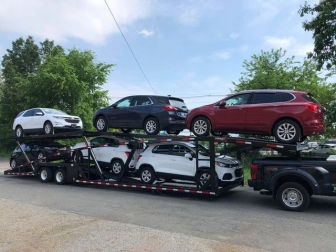
    Every Infinity Trailers car hauler comes with hydraulic loading ramps, a self-contained hydraulic system, and the straps you need for every position. Compare our 4 car, 5 car and 6 car haulers, or call us at 806-655-5500.
  • Car Trailer Winch Guide: What Size Winch Do You Need?

    Car Trailer Winch Guide: What Size Winch Do You Need?

    Sooner or later every car hauler gets a vehicle that won’t start. A winch lets you load non-running cars safely without pushing, and saves time on every job. This guide explains how to choose a car trailer winch: what size you need, the features that matter, and how to winch a car on safely.

    Why a car hauler needs a winch

    • Non-running vehicles: auction, repo, salvage and project cars often don’t run. Without a winch, you either turn down the job or push a car up a ramp, which is slow and dangerous.
    • Safety: a winch with an automatic brake holds the car if anything slips, so no one has to stand behind it.
    • Control: low cars, cars with bad brakes or steering, and slick ramps are easier to load slowly on a cable or rope.
    • More jobs: brokers and dealers often pay more for vehicles marked “inoperable”, so a winch can open up better-paying loads.

    What size winch do you need for a car trailer?

    The common rule is to choose a winch rated for at least 1.5 times the weight of the heaviest vehicle you’ll pull. A 4,000 lb car needs at least a 6,000 lb winch; a 6,000 lb pickup needs at least 9,000 lb.

    Plan for more capacity when:

    • The vehicle has flat tires, locked brakes or seized wheels. Dead weight takes far more pull than a car that rolls; many guides suggest about 2 times the vehicle’s weight.
    • You’re pulling up a steep ramp or deck angle.
    • You’re winching a full-size truck or SUV.
    • The cable is nearly full on the drum. A winch pulls hardest on the first layer of cable and loses pull as more layers wrap on.

    For a commercial car hauler that moves everything from compacts to heavy pickups, a 12,000 lb winch covers almost any load.

    Winch features to look for

    • Automatic load-holding brake: stops the vehicle the moment you stop winching. Don’t load with a winch that lacks one.
    • Wireless remote: lets you stand to the side with a clear view of the car and ramps, not in the cable’s path.
    • Steel cable or synthetic rope: steel is tough and cheap; synthetic rope is lighter, easier to handle and stores less energy if it breaks.
    • Sealed, weather-resistant build: a trailer winch lives outside in rain, dust and heat.
    • Power supply: electric winches draw heavy current, so they need a strong battery and charging from the truck.

    How to winch a car onto a trailer safely

    1. Park on level ground with the trailer hitched and the truck’s parking brake set.
    2. Put the car in neutral, release its parking brake, and have someone steer if the steering works.
    3. Attach the hook to a solid tow point or a strap around the frame, never to suspension or steering parts.
    4. Keep everyone out of the cable’s path and away from the ramps. Use the remote from the side.
    5. Winch slowly and steadily. Stop if anything binds or the car drifts off line.
    6. Once the car is in position, set its parking brake (if it works) and strap it down before releasing the winch.

    See our full guide to how to load a car hauler for strapping and load planning.

    Winch maintenance

    • Inspect the cable or rope for kinks, broken strands, fraying and burns before each use.
    • Rewind the line evenly under light tension so it doesn’t bury itself on the drum.
    • Check the battery, cables and connections; corroded terminals cut power.
    • Test the brake and remote regularly.

    Winch option on Infinity car haulers

    Every Infinity car hauler can be ordered with a 12K WARN VR12 wireless winch for $1,500. It’s rated for 12,000 lb and works from a wireless remote. Our trailers already come with a self-contained hydraulic system and battery for the ramps and decks.

    Add it when you build your trailer on any car hauler trailer page, or call or text 806-655-5500.